If you had asked me prior to 2025 whether data centers orbiting the Earth were a good idea, I would have laughed at you. There are just so many reasons (beyond cost) that make orbital data centers highly impractical. These include:
- Significant launch costs of around $6,500/kg (via Falcon 9 rideshare)
- The space environment (ionizing radiation, micrometeorites, solar flares)
- Power generation challenges (especially for GPUs)
- Heat dissipation challenges (no thermal conduction in space, only radiative cooling)
- Hardware depreciation (GPUs replacement lifecycle is ~6 years, new chip architectures released every ~2 years)
- Bandwidth challenges (key bottlenecks around ground station capacity and intersatellite links for distributed training of AI models)
Training an AI foundation model is hard enough to do well on the ground, where you don’t have to worry about launch costs, ground station bandwidth, or getting one-shotted by a coronal mass ejection. Actually, the last one may still be somewhat relevant even on the ground.
And yet, the idea is seductive: in space, you have access to infinite solar energy, uncontested room to expand, and a heat sink near absolute zero.
The idea has captivated several startups, enterprises, governments, and Elon Musk. Google announced Project Suncatcher that will deploy the company’s TPUs in a small constellation.
The Overton window for space infrastructure has definitely shifted. Let’s break down by data centers are moving off-planet.
The allure
The largest energy source in the solar system is the sun. It emits a radiant flux of 3.828×1026 Watts of power. If we could capture this power (and make humanity a Kardashev Type II civilization), it would be approximately 18 trillion times more energy than we currently consume on Earth from all sources.
Lsun = 3.828 × 1026 Watts
In low Earth orbit (LEO), solar irradiance is about 1300 W/m². A solar array in the right sun-synchronous orbit gets at least 3-4 times more energy than the same solar array placed on the ground. Terrestrial solar arrays have low capacity factors (typically <30%) because of the day/night cycle and overcast skies.
Building out a 1 GW solar array in space would require about 2.7 km² of photovoltaics, but that’s a small fraction of the area you’d need if building for the same capacity on the Earth’s surface.
The AI boom has created a massive demand for new data centers and energy is becoming one of the primary bottlenecks. The AI boom may unexpectedly be driving a nuclear renaissance as tech firms invest in nuclear fission and fusion companies. Old reactors are being brought back online. Energy generation in the United States generally has been relatively flat for decades and commissioning new power plants comes with a host of regulatory headaches and long lead times.
Energy is at the heart of the problem and why orbital data centers are so attractive. But there are other attractive features as well:
- Unlimited room to grow: no pesky zoning restrictions and no angry local committees blocking development
- “Free” cooling via the vacuum of space — although this is generally misunderstood and much harder than most people realize
- No water consumption
Along with that, launch costs are falling and may drop as low as $200/kg sometime between 2030 and 2035.
The physics reality check
Now let’s talk about what makes orbital data centers hard. If you are a venture capitalist and the founders pitching you aren’t talking about the Stefan-Boltzmann equation, walk away from the deal.
How thermal rejection actually works in space
In space there is no convection and no conduction. The only way to dump waste heat is via thermal radiation, which is governed by the Stefan-Boltzmann equation:
Q = ε · σ · A · T4
The equation is unforgiving. Q is the waste energy you need to dump into the vacuum of space with a radiator that area A. The emissivity ε (epsilon) is a property of your radiator materials and σ (sigma) is a proportionality constant. The temperature of your radiator is T and it scales as the forth power.
Let’s work out an example.
An H100 in space
Starcloud wants to bring NVIDIA H100 GPUs to space and build an orbital data center. Let’s do the math for a single GPU.
An H100 consumes 700 Watts of electrical power. Let’s assume this is the only source of waste heat and we need to keep the system at an operating temperature of 20 degrees Celsius (293.15 Kelvin)
Referring now to the Starcloud white paper, let’s assume an emissivity (ε) of 0.92. The emitted power of our radiator, then, is
P = ε · σ · T4 = 0.92 · 5.67×10-8 · (293.15)4 = 385.24 Watts/m²
Meanwhile, the radiator is also absorbing energy from incident solar radiation (1,366 Watts/m²). With an assumed absorptivity of 9%, this gives 122.94 W/m² absorbed from the sun. It’s also absorbing solar energy reflected off the Earth (albedo) and from Earth’s blackbody radiation, adding another 14.46 Watts/m².
In the final accounting, each square meter of radiator will net radiate
Pnet = Pemitted - Pabsorbed = 2 · 385.24 - 122.94 - 14.46 = 633.08 Watts/m²
The factor of 2 comes from the fact that a square meter of radiator can radiate from both sides. As Starcloud notes, if thermal pumps on the data center can shuttle more heat from GPUs to the radiator, then it can operate at higher temperature, dumping heat more efficiently.
For a single NVIDIA H100, therefore, we need about 1.1 square meters of radiator and potentially less. A DGX H100 system with 8 GPUs + storage, networking, etc. consumes 10.2 kW at max power. In space, this necessitates a radiator over 16 square meters in size.
To supply 10.2 kW of power, we would require 32.64 square meters of solar panels, assuming a 90% cell fill factor, a 22% beginning-of-life efficiency for silicon-based panels, and typical solar irradiance of >1000 kW/m².
Hardware refresh cycles
Major architectural jumps to GPU hardware occur roughly every 2 years. The efficiency gains that come from latest-generation hardware are so significant that they justify new data center investments. This is particularly true for the hyperscalers, which are in tight competition with each other. Latest-generation hardware is relevant for both training and inference. Older generations of GPUs are still kept in service for a few more years and then sold or recycled.
What does this mean for orbital data centers? Historically, whatever flew in space was running on older technology. There were many reasons for this, but it came down to the need for reliability, the length of procurement cycles, and development timelines for space missions. Hardware in space needed survive vacuum, launch loads, extreme thermal fluctuations, and radiation. Flying unproven technology was not worth the risk.
That’s still somewhat true, but development cycles are getting shorter and launch costs have come down precipitously on account of SpaceX’s reusable rocket technology. The need for radiation-hardening has also been somewhat relaxed. Consumer hardware often performs remarkably well in space. Companies like Planet Labs pioneered “agile aerospace” technology that focussed on a rapid cadence of hardware refreshes to take advantage of innovations in semiconductor technology (cameras, batteries, antennas, onboard processing, etc.).
The H100 architecture was released in 2022 as is already a few years old at the time of writing, yet this seems to be the proposed chip for launch in late 2025 or early 2026. This makes some sense: the costs will be lighter than the B200 Blackwell chips. The radiation sensitivity may already be well-characterized in testing. And with a modular data center architecture, it should be relatively straightforward to transition to newer chips when these become available.
Another challenge is that decommissioned chips may not be easily returnable to Earth. Dead GPUs in space risk becoming “stranded assets” in as little as 3-5 years. This demands that a space-based compute economy be productive enough for the data center to pay for itself on this time scale.
Orbital mechanics
The strongest argument for orbital data centers is cheap, abundant, continuous sunlight. But objects orbiting the Earth spend some fraction of their orbits on the dark side of the planet, with the Earth occulting the Sun. Time in darkness means the solar arrays need to be larger and must be paired with more batteries, or the spacecraft must hibernate through the dark portions of the orbit. This works against the unit economics of orbital data centers, so we need to be careful about our choice of orbit.
If we make the orbital radius larger, than the fraction of the orbit spent in darkness gets smaller and sunlight more continuous, at the cost of higher communication latency.
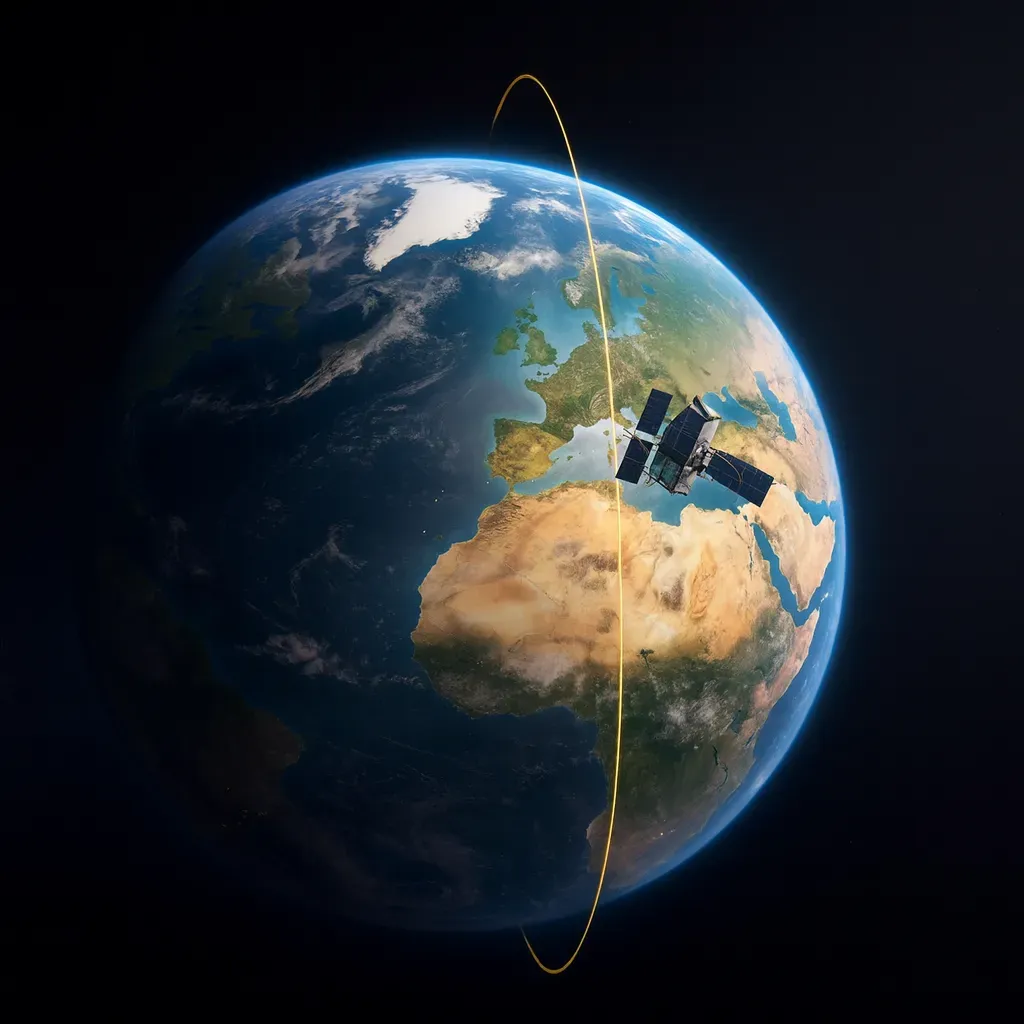
Since we want to keep launch costs down and have low-latency data links, we’re stuck with low-earth orbit (LEO) for now. The optimal LEO orbit for this project is a sun-synchronous orbit (SSO) at the dawn-dusk line (terminus). This unique orbit gets almost continuous sunlight, with minimal eclipses. The orbit precesses around the Earth once per year, with the orbital plane perpendicular to the Earth-Sun axis.
Useful work
What is the purpose of building out an orbital data center anyway? If the purpose is to train AI models, then I’m still somewhat skeptical. Modern AI training requires extremely high-bandwidth low-latency interconnects and it involves shuffling petabytes of training around. Moving that much data to orbit for training and then downlinking models doesn’t make much sense to me. Large language models (LLMs) are also trending towards doing much more compute at inference time, where low latency also matters. I’m unclear whether data centers would be well-positioned, even in a decade, to perform model serving for terrestrial users.
And that brings us to the crux of it. I believe that orbital data centers will operate on data generated in space and perform inference for other space-based systems.
Constellations of satellites are already generating terabytes of data annually, for example in Earth observation (hundreds of satellites), astronomical observatories, deep-space missions. Telecommunications satellites comprise the largest constellations and while they don’t generate very much data, they certainly move increasingly large volumes of data.
Orbital data centers will be fed with data from these missions, and may perform useful work such as image analysis, object detection, segmentation, compression, and other processing steps. These derived assets are almost always smaller in file size relative to the raw uncompressed sensor data which is currently being downlinked to Earth for processing and analysis.
The training of artificial intelligence models probably generates more hype for orbital data centers, and there is an argument for doing this. Pretraining of LLMs involves using large data corpora which could be uplinked once (or shipped on hard drives at launch) and then reused with minor updates for each training run. Once model training wraps up, only the weights of the model need to be downlinked, and these typically represent at most a few terabytes for the largest of today’s frontier models. Even if these were to grow, it would still be feasible to downlink these with the bandwidth of today’s ground stations. That said, ground stations are definitely being stressed, but startups are already tackling that challenge.
The final frontier
In 1960, the physicist Freeman Dyson published a paper in Science in which he postulated than any sufficiently advanced alien civilization would eventually begin harvesting a growing fraction of their native starlight. The resulting conversion to waste heat has prompted searches for alien megastructures around stars, which would be betrayed by a characteristic infrared signature.
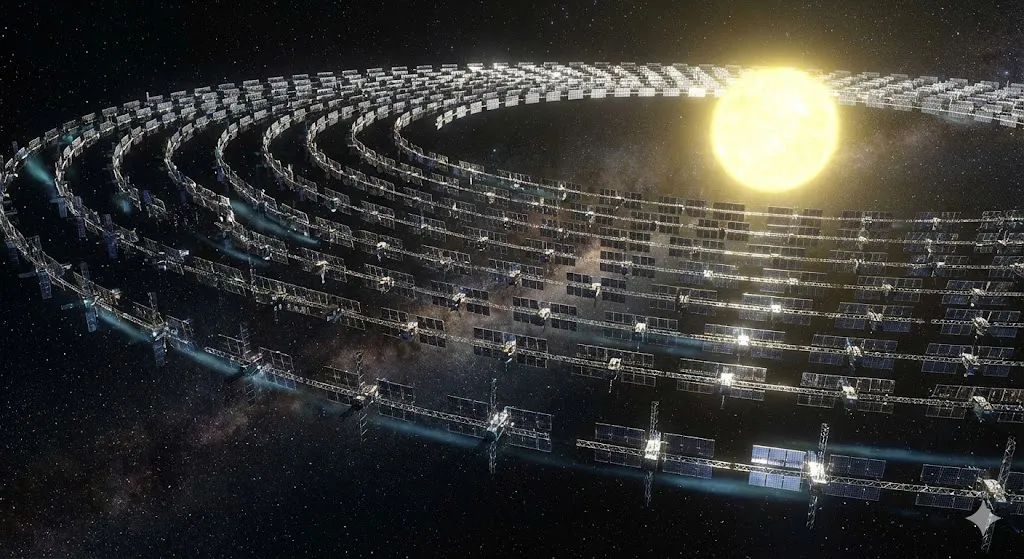
Axiomatically, if a civilization outgrows the energy available on its host planet, it must (by necessity) harvest more starlight using structures in space. From this idea came the idea of a Dyson Sphere (or, more accurately, a Dyson Swarm) — a fleet of spacecraft that orbit a star and convert solar energy into useful work: compute power, manufacturing, propulsion, etc.
Astronomers are actively looking for such structures. So far, a few candidate objects have been detected, but further study is warranted.
The final frontier of orbital data centers is to leave low-earth orbit and move to higher orbits, then to halo orbits around the Earth-Sun Lagrange points, and then finally to orbits around the sun itself. In these direct solar orbits, the sunlight is truly continuous and intense.
If the scaling laws for AI continue to hold and the power demands of tomorrows data centers scale into the TW regime, then we may have no choice but to build these compute facilities in space: gigantic constellations, millions of GPUs (or other custom chips), modular compute nodes within a self-healing mesh network knit together via laser interconnects. A deep-space backhaul network connects the Dyson Swarm back to Earth, where scientists and engineers make decisions about what problems to queue up for the Swarm intelligence to solve: breakthroughs in math and physics, novel materials, advanced pharmaceuticals and drug discovery, cures for every disease, climate mitigation and adaptation strategies. The Dyson Swarm would be Dario Amodei’s vision of a “data center of geniuses”.
Project Suncatcher is positioned as a “moonshot” by Google to place two TPUs in space aboard two satellites operated via a partnership with Planet Labs. I believe that this is Google seeing the exponential trendline of AI energy demands and following it upwards into space. A small constellation of two satellites initiates the necessary research and development on high-bandwidth inter-satellite communications, power systems, and heat dissipation that will be necessary to build much larger swarms. If Suncatcher or Starcloud or SpaceX succeed in overcoming the challenges we’ve just described, then we unlock the first nodes in a proto-Dyson Swarm. Within a decade, the swarm will be much larger and doing real work.
Ultimately, humanity’s expansion is constrained by three distinct bottlenecks: energy, intelligence, and raw materials. While Earth limits the first two, the solar system offers them in abundance. By lifting our computational infrastructure into orbit, we effectively decouple the cost of intelligence from the constraints of our planetary grid. We are beginning the long process of turning Dyson’s theoretical physics into engineering reality—evolving from a civilization that hunts for energy on the ground to one that harvests it directly from the source. The “data center of geniuses” will not just be in the cloud; it will be among the stars, fueled by the very fire that sustains us.